Following its declaration of independence, Croatia was confronted with open military aggression, the occupation of large parts of its territory, and a war that would leave a lasting mark on Europe throughout the 1990s. Yet within just a few years, it succeeded in building modern armed forces, reversing the course of the conflict, and liberating much of the occupied territory. The decisive turning point came in 1995, when Croatian military victories not only restored control over most of the remaining occupied areas in Croatia, but also fundamentally altered the military situation in Bosnia and Herzegovina. In cooperation with Bosniak forces, they paved the way for the Dayton Peace Accords, while the successful peaceful reintegration of eastern Slavonia in 1998 completed the restoration of Croatia’s full freedom and sovereignty.
The war unleashed in the early 1990s by the aggression against Croatia, and subsequently extended to Bosnia and Herzegovina, constituted the largest and deadliest armed conflict Europe had witnessed since the Second World War, prior to Russia’s aggression against Ukraine. During this conflict, Serb insurgent forces in Croatia and Bosnia and Herzegovina, benefiting from political and military support from Belgrade as well as from the Yugoslav People’s Army, occupied more than a quarter of Croatia’s sovereign territory and nearly three quarters of that of Bosnia and Herzegovina. This resulted in immense human losses, mass population displacement, and destruction on an exceptional scale.
Although hostilities dragged on for several years, the decisive resolution came in 1995, following the liberation of most of the occupied territories in Croatia during Operation Oluja (“Storm”). This offensive marked a major military turning point and fundamentally altered the balance of forces on the ground. It enabled the liberation of large areas of Bosnia and Herzegovina and led to a substantial shift in the attitude of the international community toward Belgrade, thereby opening the way to the end of the conflict and to the peaceful reintegration of the last occupied territories in Croatia.
In this context, Croatia travelled a remarkable path: from a militarily inferior and poorly equipped state at the outset of the aggression, it became a credible regional military power, capable of liberating its own territory independently, coordinating its actions effectively with Bosnian forces in Bosnia and Herzegovina, and exerting a decisive influence on the outcome of the war. Yet only a comprehensive – necessarily synthetic – understanding of the causes, course, and consequences of the Croatian War of Independence allows one fully to grasp why 1995 truly was the year of resolution: the moment when military, political, and diplomatic dynamics converged to produce a decisive historical outcome.
From Gazimestan to the Serb Rebellion and Croatian Independence
The prelude to these events was the commemoration of the 600th anniversary of the Battle of Kosovo, held on 28 June 1989 at Gazimestan in Kosovo. On that occasion, the Serbian leader Slobodan Milošević addressed a crowd of more than one million people, uttering words laden with menace: “We are again engaged in battles and facing battles. They are not armed battles, although such things should not be excluded.” Through this speech, he signalled unmistakably the direction of his policy and paved the way for the aggression to come.
The rebellion in certain Serb-majority regions of Croatia – known as the “Log Revolution” (Balvan revolucija) – erupted as early as August 1990, under the direct impetus of Belgrade. Open armed conflict began in 1991 with the Serbian aggression against Croatia, conducted with the political and military support of Slobodan Milošević’s regime in Serbia and with the direct military involvement of the Yugoslav People’s Army (JNA), whose command structure was predominantly Serbian. Beneath the official rhetoric of preserving Yugoslavia lay, in reality, a political project aimed at creating a “Greater Serbia”, including through the use of force and violence, so as to encompass all territories inhabited by Serbs, even those where they constituted only a minority. From the outset, the objective was to stifle the democratic aspirations that had emerged in Croatia after the fall of the Berlin Wall, as well as the clearly expressed will for independence manifested in the first free elections of spring 1990. Those elections were won decisively by the Croatian Democratic Union (HDZ), led by Franjo Tuđman, on the basis of an explicitly democratic and anti-communist programme.
In response to this electoral outcome, the Milošević regime in Belgrade instrumentalised the Serb minority in Croatia: it armed and encouraged it to engage in open insurrection with the assistance of the Yugoslav People’s Army, whose general staff, largely Serbian, supported Serbia’s political leadership. Despite increasingly belligerent rhetoric from Belgrade and the illegal disarmament of Croatia’s Territorial Defence – which, under the Constitution, fell under the authority of the republican authorities rather than the federal state or the JNA – Croatian leaders in Zagreb continued to hope, until the very end, that Belgrade would refrain from launching an open military offensive, the first of its kind in Europe since 1945.
However, as early as 21 December 1990, the “Serbian Autonomous Region of Krajina” was illegally proclaimed on nearly a quarter of Croatian territory. The rebellion soon degenerated into armed clashes. On 2 March 1991, the first open confrontation between Croatian police and Serb insurgents took place in Pakrac. One month later, on Easter Sunday, 31 March, Croatian policeman Josip Jović was killed at the Plitvice Lakes, becoming the first casualty of what would later be known as the Croatian War of Independence. On 1 April 1991, the self-proclaimed “government” of the Serbian Autonomous Region of Krajina declared its secession from Croatia and its attachment to Serbia, followed on 12 May by a referendum organised by the Serb insurgents on this annexation. Three days later, on 15 May, the Serbian side refused to hand over the rotating presidency of the collective Presidency of the Socialist Federal Republic of Yugoslavia (SFRY) to a Croatian representative, despite the Constitution stipulating that this office should be exercised in turn by the eight members – representatives of the six republics and the two autonomous provinces – according to the principle of primus inter pares. Serbia had thus carried out a coup within Yugoslavia’s federal institutions.
Meanwhile, on 2 May 1991, Croatian public opinion was shaken by news of the Borovo Selo massacre, a village in eastern Slavonia near Vukovar. There, Serb paramilitaries ambushed and killed twelve Croatian police officers, mutilating their bodies, while on the same day another Croatian policeman was killed in the hinterland of Zadar. These events deeply shocked Croatian society and heightened fears of a generalised conflict.
Against this backdrop, in the referendum held on 19 May 1991, more than 94 per cent of Croatian voters supported independence from the Socialist Federal Republic of Yugoslavia. Armed with this popular mandate, the Croatian Parliament proclaimed the independence of the Republic of Croatia on 25 June 1991. Slovenia did the same on the same day.
Belgrade and the JNA used these decisions as a pretext for open military intervention, justifying it by the need to preserve the Yugoslav federation and its “federal borders”. At that point, all pretence fell away, revealing the true objective: the creation of a “Greater Serbia”.
What followed was a brutal escalation of fighting. After a brief war in Slovenia – from which the Yugoslav People’s Army withdrew rapidly in order to concentrate its forces on Croatia – the JNA launched large-scale and devastating offensives aimed at seizing two thirds of Croatian territory to integrate it into the Serbian expansionist project. Serbian leaders, in contact with reactionary forces within the Soviet Union, hoped that the August coup in Moscow would overthrow President Mikhail Gorbachev; it was precisely at that moment that JNA attacks against Croatia intensified further, employing all available military means. During these decisive months, the international community, hampered by its hesitations and internal divisions, adopted a largely passive stance. This passivity stemmed both from fear of a negative reaction from Moscow and from an incomplete understanding of the true balance of power within the Soviet Union, as well as of the actual role played by President Gorbachev himself.
The Outbreak of Armed Aggression Against Croatia
The European Community attempted to respond by mobilising its “troika”, composed of the foreign ministers of the outgoing presidency, the incumbent presidency, and the incoming presidency. Through the Brioni Agreement of 7 July 1991, this mediation imposed a three-month moratorium on decisions relating to the independence of Croatia and Slovenia. Yet on the very last day of this moratorium, on 7 October 1991, the Yugoslav People’s Army launched an air attack on the Banski dvori, a historic palace in the heart of Zagreb that at the time housed the Presidency of the Republic. The attack narrowly missed killing Croatian President Franjo Tuđman, the Croatian member of the federal Presidency Stjepan Mesić, and the then Yugoslav Prime Minister Ante Marković, himself a Croat. The following day, 8 October 1991, the Croatian Parliament unanimously adopted the decision to sever all remaining constitutional ties with the Socialist Federal Republic of Yugoslavia.
At the same time, on 25 September 1991, the United Nations Security Council adopted Resolution 713, imposing an arms embargo. In practice, this measure struck a nearly defenceless Croatia particularly hard, while favouring Serbia and the Yugoslav People’s Army, which were already heavily armed. An International Conference on Yugoslavia was also established, including the Arbitration Commission of the European Community – known as the Badinter Commission – tasked with issuing legal opinions on the process of Yugoslavia’s disintegration.
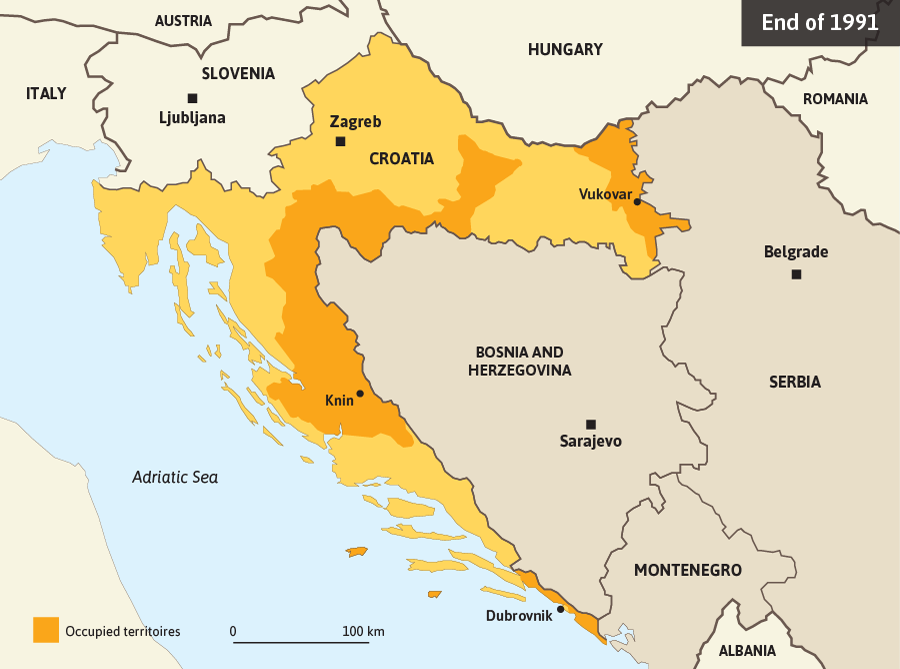
From July to December 1991, Croatia thus faced a generalised armed aggression and a high-intensity conflict. Fighting spread across more than two thirds of its territory, while the JNA and Serb paramilitary forces simultaneously attacked almost all major Croatian cities, seeking to break armed resistance and to destroy the newly proclaimed state. The most devastating bombardments struck, among others, Osijek, Vukovar, Vinkovci, Slavonski Brod, Nova Gradiška, Pakrac, Novska, Kutina, Sisak, Petrinja, Karlovac, Ogulin, Otočac, Gospić, Zadar, Šibenik, Sinj, and Dubrovnik. The fate of Ilok, Croatia’s easternmost town on the Danube, provided a particularly tragic illustration of the policy of ethnic cleansing: in the autumn of 1991, its entire Croatian population was forced into exile.
The Battle of Vukovar and the Siege of Dubrovnik – Symbols of Croatian Resistance
The Battle of Vukovar (August–November 1991) occupies a central place in the history of the Croatian War of Independence. This Danubian town in easternmost Croatia was subjected to an uninterrupted siege lasting nearly three months. Fewer than two thousand lightly armed defenders – mostly volunteers, members of the newly formed Croatian National Guard, and Croatian police – mounted a fierce resistance against an enemy vastly superior in numbers and equipment, composed of the Yugoslav People’s Army and Serb paramilitary formations. The fighting, essentially urban in character, was conducted street by street and house by house, inflicting particularly heavy losses on the attacker.
Although the town was occupied on 18 November 1991, and the last pockets of resistance in the Borovo Naselje district were not eliminated until 20 November, the defence of Vukovar played a major strategic role: it exhausted the attacking forces and brought to an end the large-scale offensive then envisaged against the rest of Croatian territory. For weeks, the defenders held out against an adversary deploying more than 30,000 troops, hundreds of tanks and armoured vehicles, dozens of aircraft, and massive artillery of all calibres. Vukovar thus emerged as a lasting symbol of Croatian courage and resistance – often described as the “Croatian Stalingrad” – while the mass crimes committed against defenders and civilians after the fall of the town became etched into collective memory as a deep wound that remains unhealed to this day.
At the same time, southern Croatia also suffered extensive destruction. The bombardment of Dubrovnik’s historic centre – a city listed as a UNESCO World Heritage Site and one of the great jewels of world culture – provoked a wave of international outrage. The date of 6 December 1991 remains particularly significant: during the most violent attack, launched simultaneously from land and sea, more than two thousand shells rained down on the city. Numerous historic monuments and civilian buildings were severely damaged, including palaces, churches, and the rooftops of the old town. This attack shocked world opinion by demonstrating that Serb-Montenegrin forces were prepared to devastate a city emblematic of Europe’s and the world’s cultural heritage.
It was in this context that the opinions delivered by the Badinter Commission played a decisive role. The Commission first established that the Socialist Federal Republic of Yugoslavia was in the process of dissolution. It further stated that no republic – not even Serbia or Montenegro – nor the entity they proclaimed in 1992 under the name Federal Republic of Yugoslavia, could be regarded as its sole legal successor, since all republics were to be considered on an equal footing. Moreover, it held that republican borders, in accordance with the principle of uti possidetis juris, were to be regarded as international borders and could not be altered without consent. Finally, it concluded that republics guaranteeing minority rights were entitled to international recognition within their existing borders. These conclusions opened the way to Croatia’s international recognition.
International Recognition of Croatia
On 19 December 1991, Serb insurgents in Croatia proclaimed the “Republic of Serbian Krajina”, a para-state entity established on occupied territories with direct political and military support from Belgrade. On the same day, Iceland recognised Croatia, becoming the first internationally recognised state to do so, while Slovenia, Lithuania, Latvia, and Ukraine had already extended recognition earlier – countries that at the time were themselves still in the process of gaining international recognition or had only just obtained it. Meanwhile, Germany announced that it would recognise Croatia in January 1992, within the framework of the European Community’s joint decision of 16 December 1991; this recognition became effective on 15 January 1992 following the favourable opinion of the Badinter Commission.
The first phase of military aggression triggered the exodus of hundreds of thousands of Croatian civilians. Under strong pressure from international diplomacy, a final ceasefire was signed on 2 January 1992 in Sarajevo, based on the Vance Plan, named after the United Nations’ special envoy Cyrus Vance. The plan provided for an end to the most intense phase of fighting and for the deployment of United Nations peacekeeping forces (UNPROFOR) in the occupied areas of Croatia.
International recognition of Croatia followed swiftly. The Holy See recognised Croatia on 13 January 1992, and on 15 January all twelve member states of the European Community were joined by Canada, Norway, Switzerland, Austria, and several other European countries. In the days that followed, recognitions from all continents followed in rapid succession – from Australia and New Zealand to Latin America, as well as the Nordic and Central European countries – conferring broad international legitimacy on Croatia in a very short time. Three months later, on 7 April 1992, the United States recognised Croatia. Shortly thereafter, on 22 May 1992, Croatia was admitted to the United Nations, upon recommendation of the Security Council and by unanimous decision of the General Assembly, as its 178th member state. On the same day, Slovenia and Bosnia and Herzegovina were also admitted to the United Nations.
The War Spreads to Bosnia and Herzegovina
At the beginning of March 1992, a referendum held in neighbouring Bosnia and Herzegovina confirmed the population’s will for independence, expressed primarily by Bosniaks (then officially designated as Muslims) and Croats. From its inception, the new state faced an extremely complex internal structure: it was composed of three constituent peoples – Bosniaks (44 per cent), Serbs (31 per cent), and Croats (17 per cent) – closely intermingled across almost the entire territory. This deeply entrenched reality rendered any attempt at territorial partition politically illusory and potentially explosive.
The Serb leadership of Bosnia and Herzegovina refused to recognise the new independence proclaimed in Sarajevo and, from April 1992 onwards, with decisive political, logistical, and military support from Belgrade, launched a war of exceptional brutality. Their objective was explicit: to create an ethnically homogeneous “Serb Republic” on conquered territories. From the very first months, the conflict was marked by mass crimes against civilians, systematic campaigns of ethnic cleansing, prolonged sieges of cities such as Bihać, Srebrenica, and Sarajevo (1992–1995), large-scale massacres, and the establishment of detention camps for Bosniaks and Croats – notably at Omarska, Keraterm, and Trnopolje – where detainees were subjected to torture, sexual violence, and extrajudicial executions.
Peace Plans and the Breakdown of the Croat–Bosniak Alliance
In the initial phase of the conflict, Bosnian Croats and Bosniaks fought side by side, mounting a common resistance to Serbian aggression. This alliance was also reflected at the political level. On 21 July 1992, in Zagreb, Croatian President Franjo Tuđman and the Chairman of the Presidency of Bosnia and Herzegovina, Alija Izetbegović, signed an Agreement on Friendship and Cooperation, based on their shared interest in defending the independence and territorial integrity of Bosnia and Herzegovina.
However, the international community increasingly embraced an explicit pragmatism. Rather than consistently defending the principles of international law, it gradually endorsed the balance of forces on the ground – an approach starkly at odds with today’s stance toward Ukraine, whose territorial integrity is rightly upheld despite Russian claims. In its attempt to impose peace, the international community multiplied diplomatic initiatives grounded in ethnic logic and territorial partition. In doing so, it effectively recognised the territorial gains achieved by force by the Serbs, who had already militarily conquered nearly 70 per cent of Bosnia and Herzegovina’s territory, granting them a share of land wholly disproportionate to their actual demographic weight (31 per cent). Such an approach – akin to a zero-sum game – turned every concession made to the Serbs into a loss for Croats and Bosniaks, gradually undermining the foundations of their alliance.
This pattern emerged as early as the Carrington–Cutileiro Plan of 18 March 1992, which proposed the cantonisation of Bosnia and Herzegovina. Although initially accepted by all three parties, the Bosnian leadership soon withdrew its signature, fearing that implementation would lead to the country’s permanent partition. Subsequent proposals by international mediators followed the same logic of ethnic division: the Vance–Owen Plan of January 1993, accepted by Croats and Bosniaks but rejected by Bosnian Serbs; and the Owen–Stoltenberg Plan, presented on 30 July 1993, which envisaged the creation of a Union of Republics of Bosnia and Herzegovina composed of three ethnic entities. Although this plan was initially signed, Bosnian leader Alija Izetbegović withdrew his signature the very next day, judging that its implementation would mean the definitive and irreversible division of the state.
It is in this context that the decision of the Croatian political leadership in Bosnia and Herzegovina must be understood. On 18 November 1991, it had established the Croatian Community of Herceg-Bosna, conceived as a political, cultural, economic, and administrative entity of Croats within Bosnia and Herzegovina. In order to adapt to the Owen–Stoltenberg framework, this entity was transformed on 28 August 1993 into the Croatian Republic of Herceg-Bosna, covering approximately 10,950 square kilometres, or nearly 21 per cent of Bosnia and Herzegovina’s territory.
Following Serbian conquests in western and eastern Bosnia, Bosniaks lost vast swathes of territory. The massive influx of tens of thousands of displaced Bosniaks into central Bosnia disrupted the existing ethnic balance and weakened a historically rooted coexistence between Croats and Bosniaks. At the same time, the acute shortage of food, medicines, and weapons – almost entirely supplied via Croatia – further exacerbated tensions.
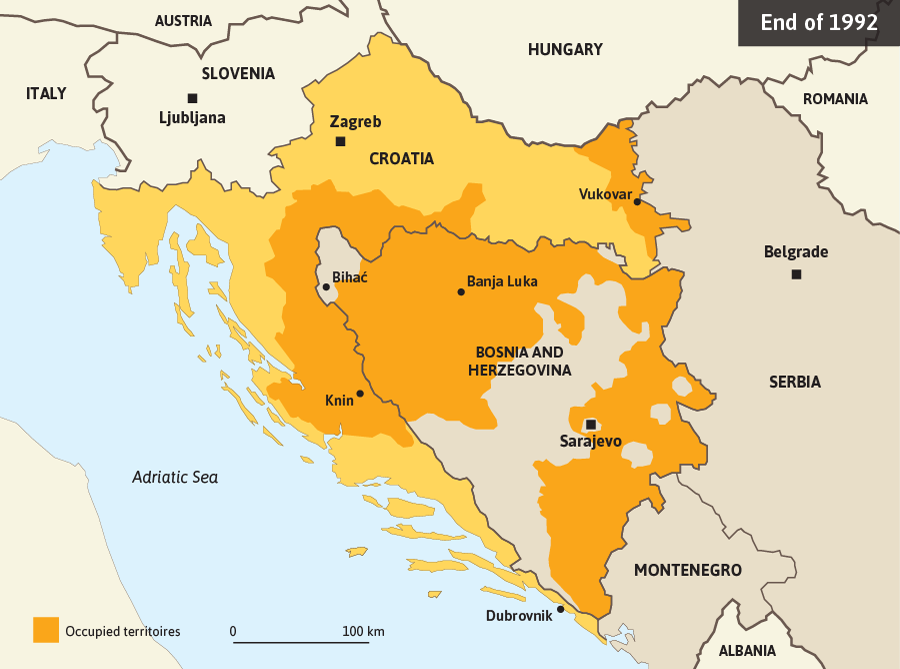
In this context, local clashes broke out between Croats and Bosniaks over control of vital resources. These confrontations were also fuelled by the desire of part of the Bosnian leadership to compensate, at the expense of the Croats, for the territorial losses suffered at the hands of Serb forces. The result was a rupture of the alliance and a Croat–Bosniak conflict that lasted throughout 1993.
That same year, on 25 May 1993, the United Nations Security Council established the International Criminal Tribunal for the former Yugoslavia (ICTY), based in The Hague – the first permanent international criminal tribunal since Nuremberg and Tokyo.
The Reversal of the Balance of Power in Croatia
As the conflict intensified in Bosnia and Herzegovina, a series of recovery operations gradually unfolded along the Croatian front. As early as the end of 1991, Croatia launched its first large-scale military actions, which enabled the liberation of a substantial part of western Slavonia. From May 1992 onwards, a succession of operations was conducted in the far south of the country: Croatian forces lifted the blockade of Dubrovnik and, by October, liberated more than 1,200 square kilometres of occupied territory, thereby restoring this historic city’s connection with the rest of the country.
In January 1993, Operation Maslenica (22–27 January) followed. During this operation, the hinterland of Zadar, the strategic Maslenica isthmus, and Zemunik Airport were liberated, followed by the Peruća dam near Sinj. Croatia thus restored territorial continuity between its continental territory and Dalmatia, as well as a key communications axis toward Bosnia and Herzegovina – an achievement of major strategic, economic, and symbolic significance.
On the international stage, pressure on the Serbian side continued to mount. A decisive turning point in the hardening of attitudes toward the Serb separatists came on 21 November 1994, when aircraft of the North Atlantic Treaty Organization (NATO), as part of Operation Deny Flight, carried out an air strike against the Udbina military airbase, located in the self-proclaimed “Republic of Serbian Krajina”, from which attacks against Bosnia and Herzegovina had been launched. At the time, this operation represented the most significant air combat action undertaken in Europe since the Second World War, as well as the largest military operation conducted by NATO up to that point in its history.
Almost simultaneously, on 30 May 1994, Croatia took a powerful symbolic step in strengthening its sovereignty despite the ongoing war: the Croatian dinar, introduced in 1991, was replaced by a new national currency, the Croatian kuna.
In this context, the first visit of Pope John Paul II to Croatia, in September 1994, gave fresh impetus to the country’s international affirmation and provided powerful moral support to the population. In Zagreb, nearly one million faithful gathered on this occasion, in what remained the largest public assembly in Croatian history. Widely covered by international media, the visit was perceived as confirmation of Croatia’s growing international standing and as an explicit endorsement of its struggle for freedom and independence.
The Restoration of the Croat–Bosniak Alliance: A Key to the Reversal
A major strategic turning point in the conflict had occurred several months earlier, on 18 March 1994, when – under the auspices of American diplomacy and with the active support of Croatia and Türkiye – the alliance between Croats and Bosniaks was restored. The Washington Agreements established the Federation of Bosnia and Herzegovina as a joint entity of Croats and Bosniaks. In addition to Croatia and Bosnia and Herzegovina, the Croatian Republic of Herceg-Bosna was also among the signatories. In practice, the latter continued to exist after the adoption of the Federation’s Constitution on 30 March 1994, until its voluntary dissolution on 14 August 1996, when its competences were transferred to the federal institutions. This new institutional framework made coordinated military action possible between the Croatian Defence Council (HVO) and the Army of the Republic of Bosnia and Herzegovina (ARBiH) against Serbian forces.
Almost simultaneously, on 29 March 1994, a ceasefire was concluded in Croatia, under Russian mediation, between the Croatian Army and the “Serbian Army of Krajina”, the armed force of the Serb separatists who had unilaterally proclaimed the “Republic of Serbian Krajina” in 1991 – a para-state entity covering more than a quarter of Croatian territory. By the end of the same year, an economic agreement was signed in Zagreb between the Croatian government and the Serb rebel leadership. It enabled the restoration of essential infrastructure – motorways, oil pipelines, and electricity networks – and forced the insurgents into substantial concessions, marking the beginning of the erosion of a previously rigid and intransigent position.
It was against this backdrop of total war – characterised by a high number of civilian casualties, shifting military alliances, and steadily intensifying international pressure – that the year 1995 opened: the year of resolution. It was marked by an acceleration of military operations, a decisive reversal of the balance of power on the ground, and a more direct engagement by the United States in the search for a political settlement, which ultimately culminated in the signing of the Dayton Peace Accords at the end of the year.
From 1994 onwards, military cooperation between Croats and Bosniaks began to yield tangible results. In November, HVO forces and the Army of the Republic of Bosnia and Herzegovina achieved their first major joint victory during Operation Cincar, liberating the strategic Kupres plateau, a key junction linking central Bosnia with western Herzegovina. At the same time, in the far north-west of the country, in the Bihać region, the Army of the Republic of Bosnia and Herzegovina launched an offensive as part of Operation Grmeč-94. Serb separatist forces from Bosnia and Herzegovina and Croatia, supported by the followers of Fikret Abdić – a Bosnian political leader openly opposed to the authorities in Sarajevo – responded with a violent counter-offensive.
In order to relieve pressure on Bihać, Croatia launched Operation Zima-94 in December 1994 along the Dinara–Livno–Bosansko Grahovo axis. This offensive secured control of strategic high ground toward Knin, the self-proclaimed “capital” of the Serb insurgents in Croatia, thereby initiating their gradual encirclement and preparing the ground for the decisive military operations of the following year.
1995: Croatia Regains the Initiative
In January 1995, confronted with the passivity and ineffectiveness of the United Nations in enforcing the demilitarisation of Serb forces in the occupied territories, Croatia publicly expressed its dissatisfaction and announced that it would not extend the mandate of the UNPROFOR peacekeeping mission. In response, the United Nations Security Council adopted Resolution 981 on 31 March 1995, by which the UN mission in Croatia was renamed UNCRO (United Nations Confidence Restoration Operation in Croatia) and granted an expanded mandate, including the monitoring of the state border with Serbia and Bosnia and Herzegovina.
Within this new framework, Croatia regained the military initiative on the ground. In April 1995, it launched Operation Skok-1 in the Dinara mountain range, significantly strengthening its positions on the southern front. The following month, in May, Operation Bljesak liberated the last occupied territory in western Slavonia, thereby restoring motorway continuity between the western and eastern parts of the country. In retaliation, Serb forces launched rocket attacks on the centre of Zagreb, killing several civilians and injuring many others.
In order to facilitate the reintegration of the Serb population of western Slavonia, the Croatian authorities offered an accelerated procedure for the regularisation of Croatian citizenship, taking into account the fact that Croatia’s independence had been proclaimed while the region remained under insurgent control. Despite this initiative, several thousand Serbs refused the offer and requested to be escorted to the Serbian border by United Nations peacekeeping forces.
A few weeks later, on 30 May 1995, a large military parade was held at Jarun in Zagreb. For the first time, Croatia publicly displayed newly acquired military equipment and demonstrated the growing operational capability of its armed forces. The event carried an explicit political message: it was also intended as a signal to the Serb insurgents, urging them to abandon their secessionist ambitions and to accept peaceful reintegration within the constitutional order of the Republic of Croatia.
Bosnia and Herzegovina: Escalation of Violence and the Genocide of Srebrenica
In May 1995, Bosnian Serb forces launched a large-scale offensive in the north-east of Bosnia and Herzegovina, known as Operation Plamen-95, with the aim of capturing the Orašje region. The attack ultimately failed. In order to prevent further threats and consolidate its strategic positions, Croatia launched Operation Skok-2 in early June 1995, targeting key strategic points in western Bosnia and Herzegovina, notably Glamoč and Bosansko Grahovo.
At the same time, indiscriminate Serbian shelling of civilian areas reached a critical level, particularly following the massacre in Tuzla on 25 May 1995, in which seventy-one civilians were killed. In response, NATO carried out air strikes against Serb positions, including targets in Pale, the political centre of the Bosnian Serbs. In retaliation, Serb forces captured approximately three hundred United Nations peacekeepers in Bosnia and Herzegovina, using them as hostages and human shields in an attempt to deter further air operations. This act of humiliation inflicted upon the “blue helmets” – among whom were French and British soldiers – provoked strong reactions among European leaders, notably French President Jacques Chirac and British Prime Minister John Major, and accelerated the decision to establish a Rapid Reaction Force (RRF), intended to strengthen the UN mandate and enhance the protection of its contingents on the ground.
It was against this backdrop of escalating violence that, in July 1995, one of the most atrocious crimes of the conflict took place: the fall of the protected enclave of Srebrenica. During Operation Krivaja-95, Bosnian Serb forces seized the town, despite its formal protection by the United Nations, and proceeded to carry out the systematic execution of more than eight thousand Bosniaks – men and adolescent boys. This crime has been unequivocally recognised as genocide by international courts.
Croatia’s Decisive Intervention: Operations Ljeto-95 and Oluja
Only days after the Srebrenica massacre of 11 July 1995, Serb forces launched Operation Mač-95 with the objective of capturing the Bihać enclave. Subjected to continuous siege for three and a half years, Bihać sheltered more than one hundred thousand people, predominantly Bosniaks, who now faced the threat of a new humanitarian catastrophe and the prospect of mass slaughter.
It was in this context that the Presidents of Croatia and Bosnia and Herzegovina, Franjo Tuđman and Alija Izetbegović, signed a Declaration on Military Cooperation in Split on 22 July 1995. Three days later, Croatian forces launched Operation Ljeto-95, liberating Bosansko Grahovo and Glamoč and opening a strategic axis toward Knin, the principal stronghold of the Serb rebellion in Croatia.
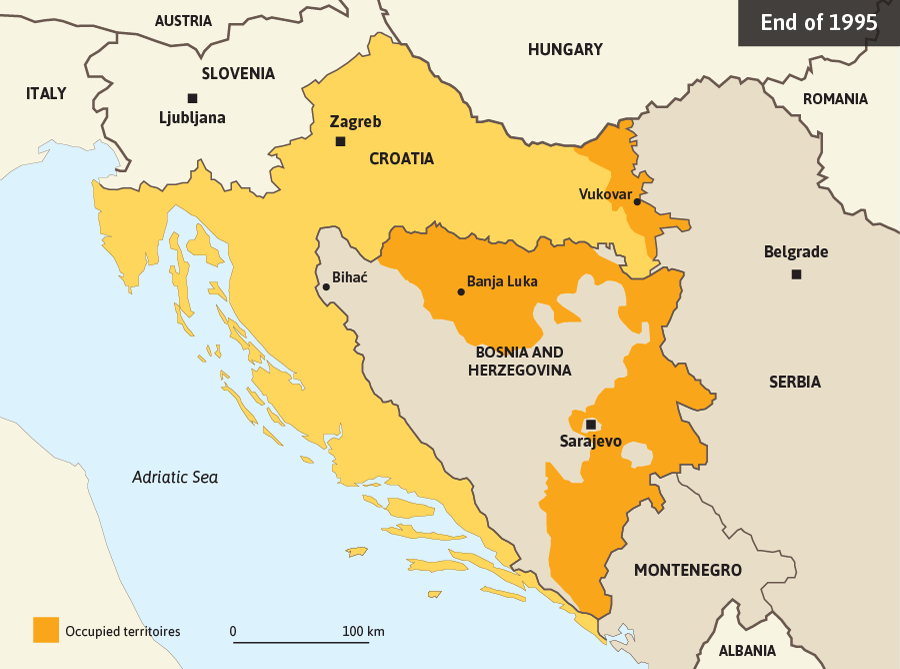
Operation Oluja began on 4 August 1995 and remains the largest military operation in Croatian history. Approximately two hundred thousand troops were deployed: nearly one hundred and forty thousand took part in a decisive breakthrough along a front extending over more than seven hundred kilometres, while the remainder were stationed in eastern Slavonia and the southern part of the country to prevent any potential Serb counter-offensive. In less than four days, 10,400 square kilometres were liberated – almost one fifth of the territory of the Republic of Croatia – and the self-proclaimed “Republic of Serbian Krajina” ceased to exist.
On 5 August, Knin was liberated, the stronghold of the Serb insurgents and a symbol of years of occupation. Raised above the Knin fortress – an enduring emblem of the royal city of King Zvonimir – the Croatian flag flew once again, becoming a powerful symbol of victory and regained freedom. Although military operations were not yet complete, a genuine wave of popular celebration swept across the country: in towns and cities throughout Croatia, people celebrated the conviction that the war was drawing to a close and that the full liberation of the occupied territories was now imminent.
At the same time, beginning on 4 August 1995, the command of the Serb separatist forces ordered and organised the evacuation of the Serb population from the occupied territories of northern Dalmatia, Lika, Kordun and Banovina. Even before the Croatian army entered Knin, between 150,000 and 200,000 people – predominantly civilians, but also members of Serb paramilitary formations – left Croatia in organised convoys, despite repeated appeals by the Croatian authorities to lay down their arms and remain in their homes, accompanied by guarantees of amnesty.
In the days and weeks following Operation Oluja, isolated criminal acts claimed the lives of several dozen Serb civilians who had chosen to remain in Croatia. Some of those responsible were subsequently identified, arrested, and prosecuted by the Croatian judicial authorities.
Operation Oluja also lifted the siege of the Bihać pocket in north-western Bosnia, thereby saving more than one hundred thousand Bosniaks who had been encircled by Serb forces since 1992 from a fate almost certainly comparable to that which had befallen Srebrenica a month earlier. Militarily and politically, the operation marked a decisive turning point, opening the way to the final settlement of the conflict.
Final Offensives in Bosnia and Herzegovina
Buoyed by the momentum of their previous successes, Croatia and Bosnia and Herzegovina launched a new series of decisive offensives in the autumn of 1995. In September, Croatian forces carried out Operation Maestral, liberating several Bosnian towns of major strategic importance, including Jajce, Drvar and Šipovo. Shortly thereafter, the Army of the Republic of Bosnia and Herzegovina, composed predominantly of Bosniak units, launched Operation Sana-95, which resulted in the recapture of Ključ and Bosanska Krupa.
The Croatian attempt to cross the River Una on 18 and 19 September 1995, during Operation Una, ended in failure. This isolated setback, however, did not alter the overall momentum. As part of Operation Južni potez (8–12 October 1995), the town of Mrkonjić Grad was liberated, and Croatian artillery was deployed less than twenty-three kilometres from Banja Luka, the principal political and military centre of the Bosnian Serbs, generating palpable fears of encirclement.
Toward Peace: The Dayton and Erdut Agreements
Faced with the advance of Croat–Bosniak forces on the ground, NATO air strikes conducted in August and September 1995 against Bosnian Serb military installations as part of Operation Deliberate Force, and Serbia’s growing diplomatic isolation, Slobodan Milošević ultimately agreed to open negotiations in order to avoid the loss of territorial gains accumulated over more than four years of war.
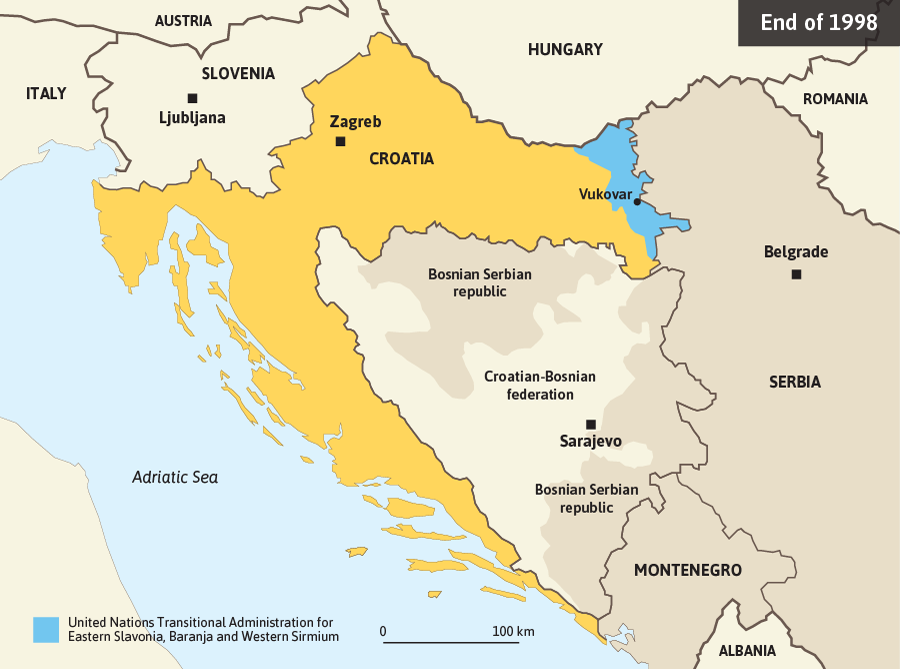
The cessation of hostilities was sealed by two major agreements. The first was the Basic Agreement on Eastern Slavonia, Baranja and Western Sirmium (known as the Erdut Agreement), signed on 12 November 1995, separately in Zagreb and Erdut. It paved the way for the peaceful reintegration of eastern Slavonia – the last occupied territory of Croatia, then under United Nations administration and separated from Serbia only by the Danube. The agreement provided for the peaceful return of the region to Croatian sovereignty within one to two years and for the establishment of a dedicated United Nations mission: the United Nations Transitional Administration for Eastern Slavonia, Baranja and Western Sirmium (UNTAES), placed under the command of the American General Jacques Paul Klein.
The second, politically decisive agreement was the Dayton Peace Agreement. From 1 to 21 November 1995, intensive negotiations were held at the Wright–Patterson Air Force Base in Dayton, Ohio, under United States auspices, culminating in a complex but decisive political compromise. The agreement was formally signed on 14 December 1995 at the Élysée Palace in Paris by Presidents Franjo Tuđman, Alija Izetbegović and Slobodan Milošević, under the sponsorship of French President Jacques Chirac, US President Bill Clinton, German Chancellor Helmut Kohl, British Prime Minister John Major, Russian Prime Minister Viktor Chernomyrdin and the President-in-Office of the European Council, Spanish Prime Minister Felipe González.
The Dayton Agreement established the constitutional architecture of a single, internationally recognised state of Bosnia and Herzegovina, composed of two entities: the Federation of Bosnia and Herzegovina (the Croat–Bosniak entity), covering 51 per cent of the territory, and the Republika Srpska (the Serb entity), with 49 per cent. The Brčko District was later constituted, following international arbitration in 1999, as a separate administrative unit placed under the direct sovereignty of the state of Bosnia and Herzegovina, outside the two entities. The agreement also confirmed the status of the three constituent peoples – Bosniaks, Croats and Serbs – as the foundation of the country’s constitutional order, while recognising the rights of other communities.
In January 1996, the United Nations established the United Nations Mission of Observers in Prevlaka (UNMOP), on a strategic peninsula at the southernmost tip of Croatia, at the entrance to the Bay of Kotor and along the border with Montenegro. The mission temporarily provided international supervision of the area and de facto confirmed its belonging to the Republic of Croatia. The mission concluded successfully in December 2002.
The Cost of War and Responsibility for Crimes
The material destruction and human suffering left deep and lasting scars. In Croatia, war damage has been estimated at the equivalent of 160 per cent of pre-war GDP, while 15 per cent of the housing stock was damaged or destroyed. By way of comparison, the earthquake and tsunami that struck Japan in 2011 caused economic losses equivalent to 8 per cent of GDP and the destruction of 1.8 per cent of the housing stock. In Japan, 561 square kilometres (0.15 per cent of the national territory) were flooded; in Croatia, 1,174 square kilometres were contaminated by landmines – proportionally fourteen times more – and demining operations extended over three full decades.
Behind these figures, however, lies the heaviest tragedy of all: the loss of human life. According to data from the Croatian Memorial and Documentation Centre of the Homeland War, the conflict claimed between 19,500 and 20,000 lives. Of these, just under 14,000 were Croats and residents of territories under government control, including approximately 8,700 combatants, while around 5,300 people were killed in the then-occupied territories, among them more than 3,700 soldiers of the Yugoslav People’s Army (JNA) and Serb forces. The true number of casualties is likely higher, as part of the data remains buried in the archives of the JNA and the Serbian Ministry of the Interior. Among the civilian victims, some four hundred children occupy a particularly painful place in the collective memory. Thousands of civilians and tens of thousands of combatants were also wounded.
The war in Bosnia and Herzegovina exacted an even heavier human toll. According to the most reliable national and international demographic estimates, between 97,000 and 104,000 people were killed between 1992 and 1995: approximately 64,000 to 65,000 Bosniaks, 25,000 Serbs and 8,000 Croats, while millions of inhabitants were forced to flee their homes. The scale of the violence – particularly mass crimes and the genocide of Srebrenica – left a lasting imprint on the contemporary history of Bosnia and Herzegovina and the wider region. In this overall assessment, more than 90 per cent of the human losses were the direct consequence of Serb aggression and the war crimes that accompanied it. The Croat–Bosniak conflict of 1993–1994, largely confined to central Bosnia, accounted for approximately 8 to 10 per cent of the total victims; among them, nearly two thirds were Bosniaks and about one third Croats.
Nowhere was Croatian resistance as dramatic and tenacious as in Vukovar – the first European city to be devastated by aerial bombardment since 1945 – which held out for 87 days, one day longer than Mariupol would do three decades later when it was encircled by Russian forces. Despite sustained efforts, 1,740 people were still listed as missing in February 2026, a wound that remains open in Croatian society. This is why 18 November has become the day on which all of Croatia pays tribute to the victims of the War of Independence and to the sacrifice of Vukovar and Škabrnja. On that day, millions of candles illuminate squares, streets and windows, silently recalling the price of freedom.
History’s irony lay in the fact that the man who had unleashed the war, Slobodan Milošević, was indicted before the International Criminal Tribunal for the former Yugoslavia for genocide, crimes against humanity and war crimes. Serbian authorities themselves extradited him to The Hague in 2001 – on 28 June, the anniversary of his bellicose Gazimestan speech in 1989, where it had all begun. He died in detention in 2006, thus evading a judicial verdict, but not the unforgiving judgment of history, which has permanently recorded him as the “Butcher of the Balkans”. All the principal political and military leaders of the Serb separatists were likewise convicted by international justice – in Croatia (Milan Babić, Milan Martić) and in Bosnia and Herzegovina (Radovan Karadžić, Ratko Mladić) – for crimes against humanity, and, in the Bosnian case, for genocide. From this stark balance of destruction, victims and responsibility emerges an understanding of the value of freedom and of lasting peace.
The Price of Freedom and Peace as a Legacy
The end of 1995 marked the conclusion of one of the most tragic and complex conflicts Europe had experienced since the Second World War. Despite an initially highly unfavourable balance of power, Croatia succeeded in defending its territory, building modern armed forces, establishing democratic institutions and securing international recognition as a sovereign state. At the same time, it helped bring an end to the conflict between Bosniaks and Croats in Bosnia and Herzegovina, restored the alliance with the Bosniaks, and played a decisive political role in steering the Croat leadership in Bosnia and Herzegovina toward acceptance of the peace plans.
In doing so, Croatia played a vital role in the survival of Bosnia and Herzegovina during the war: almost all humanitarian and military aid destined for the country necessarily transited through Croatian territory. Without this support, Bosnia and Herzegovina would in all likelihood not have survived as a state. Today it remains an internationally recognised country, structured around two entities and founded on three constituent peoples.
The strategic reversals achieved on the battlefield – most notably Operation Oluja, which, by breaking the encirclement of Bihać, prevented a tragedy comparable to that of Srebrenica – created the conditions for the opening of peace negotiations and made possible the peaceful reintegration of the last occupied territories in eastern Croatia. While it did not fulfil all expectations, the Dayton Agreement brought hostilities to an end and opened the way to a long but indispensable process of reconstruction, refugee return, justice for victims and gradual reconciliation.
On the basis of the new military balance, the peaceful reintegration of eastern Slavonia was completed within the agreed timeframe: on 15 January 1998, the last occupied territory was reintegrated into Croatia, which thereby completed the restoration of its full sovereignty and emerged from the war without any territorial loss. Successfully implemented in just two years, the UNTAES mission became the most successful peacekeeping operation in the history of the United Nations. Only then was Croatia able to devote itself fully to reconstruction and economic development. Just eleven years after the departure of the last UN peacekeepers, it became a member of NATO in 2009, followed by full membership of the European Union in 2013.
The Year of Resolution
The events of 1995 demonstrated that there can be no lasting peace without a balance of power, and no viable political solution without strategic determination in implementing key political and military priorities, diplomatic clarity, and due regard for historical realities. Despite immense sacrifices and destruction, Croatia achieved what had long seemed beyond reach: defending itself under an international arms embargo, building a state and democratic institutions, and securing full international legitimacy. It played at once a decisive military and diplomatic role in bringing the war to an end and paved the way for the peaceful reintegration of eastern Slavonia.
For all these reasons, history will rightly remember 1995 as the year of resolution – the year in which a decisive victory opened for Croatia a new chapter of peace, freedom, and a European future.
Published in: “1995.”, Zoran Filipović, Zagreb, 2026.